Key takeaways
- Geotextile fabric is a permeable textile used in soil to separate, stabilize, filter, drain or protect.
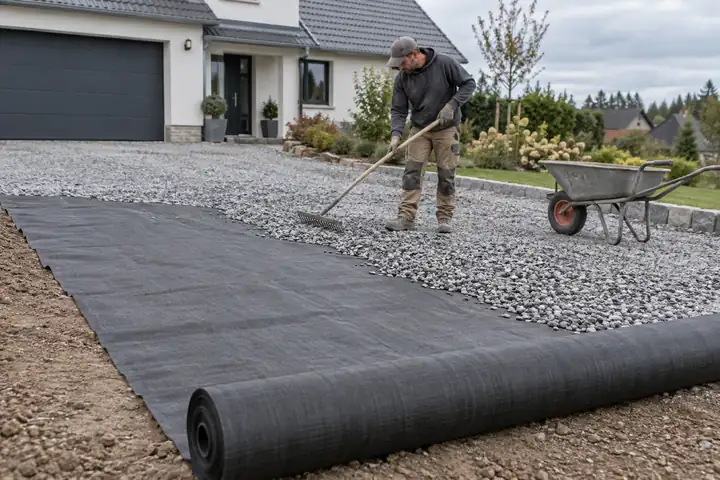
- Woven geotextile (usually slit-film PP) is strong and low-stretch: best for separation and stabilization under roads, driveways and pavers.
- Non-woven (needle-punched) is felt-like and highly permeable: best for filtration and drainage in French drains and behind walls.
- Landscape fabric is a lighter woven or non-woven sheet made for weeds, not loads.
- Specify by function and property values, not just weight.
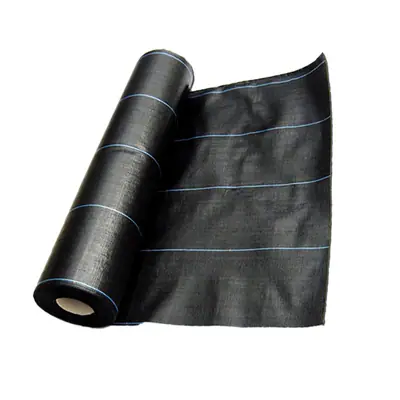
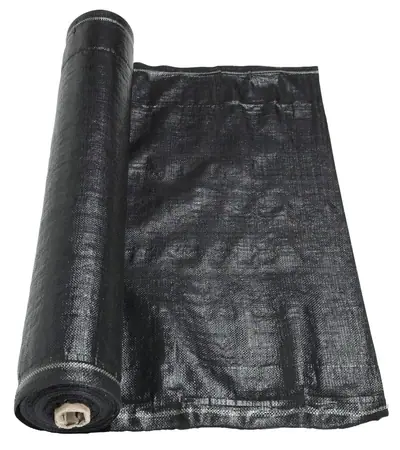
Geotextile fabric is a permeable synthetic textile, usually polypropylene, placed in or on soil to separate layers, stabilize weak ground, filter water, drain it or protect liners. There are two main kinds. Woven geotextile is strong and stiff, and is used to separate and stabilize stone from soft soil under driveways, roads and pavers. Non-woven geotextile is a thick felt that lets water through easily while holding back soil, so it is used for filtration and drainage, such as wrapping French drains. Choose by the job the fabric has to do.
What is geotextile fabric?
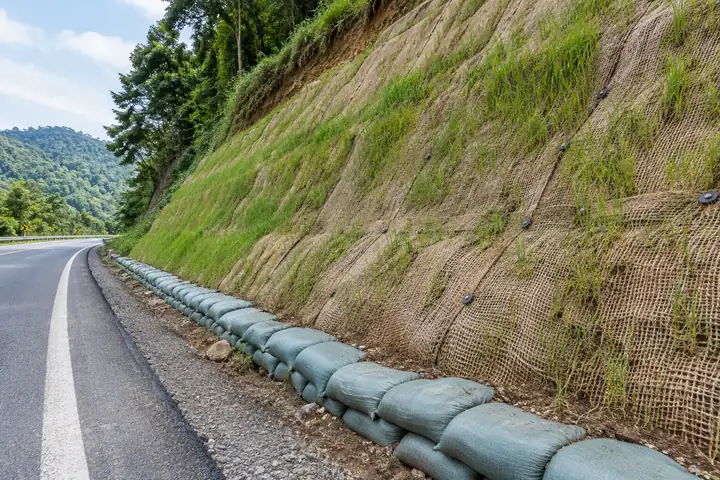
Geotextiles are a family of geosynthetics, alongside geogrids, geomembranes, geocells and erosion mats. The geotextile material is almost always polypropylene, sometimes polyester. Polypropylene geotextile dominates because PP is light, inexpensive, chemically resistant and does not rot or absorb water.
The five functions
| Function | What it does | Typical application | Usual fabric |
|---|---|---|---|
| Separation | Keeps aggregate and soil from mixing | Driveways, roads, paver bases, rail beds | Woven |
| Stabilization / reinforcement | Spreads loads over soft subgrade, adds tensile strength | Haul roads, parking areas over soft clay | Woven (heavy) |
| Filtration | Lets water pass, holds back soil | Drains, behind riprap and retaining walls | Non-woven, or woven monofilament |
| Drainage | Carries water within the fabric plane | Behind walls, under landfills | Thick non-woven |
| Protection / cushioning | Protects geomembranes and liners from puncture | Ponds, landfills, tanks | Heavy non-woven |
Woven geotextile fabric
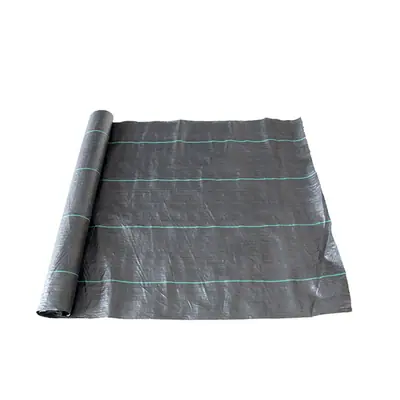
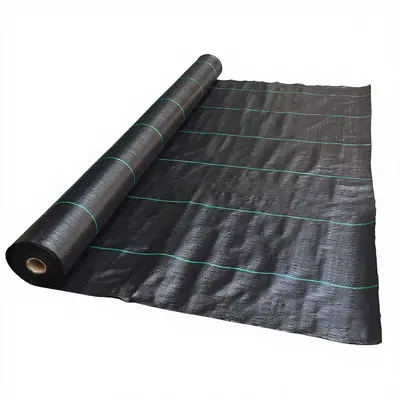
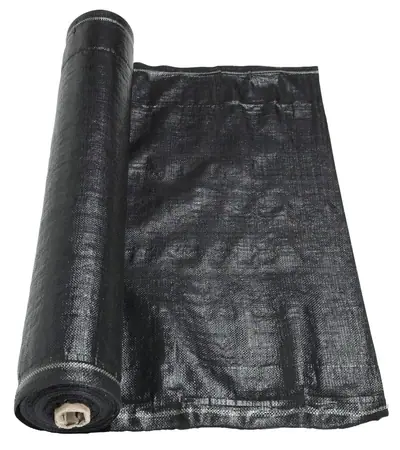
Woven geotextiles are made by weaving polypropylene tapes (slit film) or round monofilaments on looms, the same basic process used to make woven sacks and weed mat.
Slit-film woven: flat tapes, tightly woven. Very high strength for its weight and low elongation, but relatively low water flow, and fine soils can blind it. Used for separation and stabilization.
Monofilament woven: round yarns with regular openings, like a screen. Higher water flow and more predictable openings. Used as woven filter cloth under riprap and in shoreline protection. Polypropylene filter cloth of this type is also used in industrial filtration (filter presses, dewatering).
Typical properties (slit-film woven, illustrative ranges):
| Property | Light separation | Heavy stabilization |
|---|---|---|
| Grab tensile strength | about 200 lb (890 N) | 300 lb (1,330 N) or more |
| Elongation at break | 15–20% | 15–20% |
| Water flow rate | about 4–10 gal/min/ft² (160–400 L/min/m²) | about 4–8 gal/min/ft² |
| Apparent opening size (AOS) | US sieve 30–40 (0.6–0.425 mm) | US sieve 30–40 |
Exact values vary by product; check the data sheet.
Non woven geotextile fabric
Non-woven geotextiles are made by laying polypropylene (or polyester) staple fibers or continuous filaments into a web and needle-punching them so the fibers interlock. The result looks like felt.
- High permeability, often 10 to 30 times the flow rate of slit-film woven
- Fine, three-dimensional pore structure that traps soil particles while letting water through
- Higher elongation, typically 50% or more, so it conforms to uneven surfaces and resists puncture by stretching
- Lower tensile strength per unit weight than woven
Non-woven geotextile is sold by weight per area:
| Weight | Approx. g/m² | Typical use |
|---|---|---|
| 3 oz/yd² | ~100 | Light filtration, landscape drainage |
| 4 oz/yd² | ~135 | French drains, trench wraps |
| 6 oz/yd² | ~200 | Behind retaining walls, drainage under paving |
| 8 oz/yd² | ~270 | Riprap underlay, heavier drainage |
| 10–16 oz/yd² | ~340–540 | Geomembrane protection |
A non-woven geotextile filter fabric is the standard wrap for drains. See geotextile fabric for driveways, French drains and retaining walls for build details.
Woven vs non woven geotextile: side-by-side
| Woven (slit film) | Non-woven (needle-punched) | |
|---|---|---|
| Appearance | Flat, tape weave, like a sack | Felt, fuzzy |
| Tensile strength | High | Moderate |
| Elongation | Low (15–20%) | High (50%+) |
| Water flow | Low to moderate | High |
| Clogging risk with fine soils | Higher | Lower |
| Main functions | Separation, stabilization | Filtration, drainage, protection |
| Typical jobs | Driveways, roads, paver bases, soft ground | French drains, wall drainage, riprap, pond liners |
| Cost per m² for equivalent use | Usually lower | Usually higher |
Rule of thumb: if water must move through the fabric, use non-woven. If load is the problem, use woven.
Woven vs non woven landscape fabric
The same distinction applies to garden fabrics, on a lighter scale:
- Woven landscape fabric is stronger, resists punctures from gravel, and lasts longer. Best under paths, rock and in commercial rows.
- Non-woven landscape fabric (thin spunbond) drains faster and is easy to cut, but tears and lets weeds root into it. Best for short-term beds under mulch.
More detail is in the heavy duty landscape fabric guide.
Geotextile vs landscape fabric: what is the difference?
People often ask whether they can use one for the other.
| Landscape fabric | Geotextile fabric | |
|---|---|---|
| Designed for | Blocking weeds | Engineering functions under load |
| Typical weight | 30–130 g/m² | 100–500+ g/m² |
| Specified by | Weight, UV, color | Tensile, puncture, AOS, permittivity, flow rate |
| UV stabilization | Often high (may be exposed) | Moderate; usually buried quickly |
| Use under driveways | Not recommended | Yes (woven) |
| Use as weed barrier | Yes | Works, but heavier than needed |
Geotextile weed barrier: a woven geotextile under gravel works perfectly well as a weed barrier, and contractors often use one product for both jobs. A non-woven geotextile also blocks weeds when buried, but weeds that germinate on top can root into its fibers.
Landscape fabric as geotextile: heavy woven weed mat of 130 g/m² or more can do light separation under garden paths and patios. For driveways, roads and walls, use a geotextile with published strength and flow values.
What is heavy duty geotextile fabric?
Heavy duty geotextile fabric usually means a woven slit-film or woven monofilament product with high grab tensile and puncture strength, used for stabilization over very soft ground, haul roads, crane pads and heavy equipment yards. In non-woven terms, heavy duty means 8 oz/yd² and up, used for protection and riprap.
For site work, specifications are often based on a national standard; in the US, many agencies refer to AASHTO M288 classes. Ask the project engineer which class or property values apply.
EGP's heavier woven PP mats, such as PP Weed Control Mat High Load Capacity for Construction and Reinforced PP Weed Mat with Tear-Resistant Construction, are built for traffic and abrasion on industrial sites. For engineered applications, request the property data you need and confirm it against the project specification before ordering.
How to choose geotextile material
- Name the function: separation, stabilization, filtration, drainage or protection.
- Describe the soil: clay, silt, sand or gravel; firm or soft; wet or dry.
- Describe the load: foot traffic, cars, trucks, construction equipment.
- Check flow needs: if water must pass, compare permittivity and AOS with the soil's particle size.
- Check survivability: sharp stone and heavy equipment need higher puncture and tear strength.
- Check exposure: if the fabric will sit uncovered for weeks, ask for UV-stabilized grades.
Where to buy geotextile fabric
- Small residential jobs: building supply yards, landscape supply stores and farm stores usually stock woven and non-woven rolls in widths of 3–12.5 ft.
- Contractors and civil projects: geosynthetics distributors supply certified products with data sheets.
- Distributors, importers and large farms: manufacturers supply full rolls and containers directly.
EGP manufactures woven polypropylene fabrics, including permeable heavy grades such as Industrial PP Weed Control Mat with Permeable, with custom widths, weights and roll lengths for distributors and contractors. We do not produce needle-punched non-woven geotextile. See the Woven Rolls & Weed Mat range or contact us with your specification. Importing for the first time? Our checklist for importing woven products from China covers samples and inspection.
Frequently asked questions
Which is better, woven or non-woven geotextile?
Neither is better overall. Woven is better for separation and stabilization under loads, such as driveways. Non-woven is better wherever water must flow through, such as French drains and behind retaining walls.
Can I use landscape fabric instead of geotextile?
For light garden paths and patios, a heavy woven landscape fabric can work as a separator. For driveways, drains and walls, use a geotextile with published strength and flow properties.
What is polypropylene filter cloth used for?
Woven polypropylene filter cloth is used in industrial filter presses and dewatering, and as woven monofilament geotextile under riprap and in shoreline protection, where water must pass while soil is held back.
Does geotextile fabric stop weeds?
Buried under gravel, it blocks weeds from below like landscape fabric. Weeds that sprout on top of the stone can still root into non-woven fibers, so woven types stay cleaner.
Is geotextile fabric made of polypropylene?
Most is. Polypropylene geotextile is the most common type because it resists chemicals and rot and is light. Some non-wovens and high-strength wovens use polyester.