Key takeaways
- Driveway: woven geotextile under the stone base for separation and stabilization; overlap 12–36 in depending on soil.
- French drain: non-woven geotextile wraps the gravel; woven slit-film and weed fabric can clog.
- Retaining wall: non-woven fabric separates the drainage stone from backfill soil; geogrid, not fabric, reinforces taller walls.
- Never drive directly on exposed fabric; always keep at least 6 in (15 cm) of stone between tires and fabric.
For a gravel driveway, use a woven geotextile under the stone base. It separates the aggregate from the soil and spreads wheel loads so the stone does not sink and rut. For a French drain and the drainage zone behind a retaining wall, use a non-woven geotextile, because water must flow through the fabric freely while soil is held back. Getting this one choice right prevents the two most common failures: driveways that turn to mud and drains that clog.
This guide gives the build-ups, depths and fabric choices for all three projects. For the background on fabric types, see geotextile fabric: woven vs non-woven.
Geotextile fabric for a driveway
Why put fabric under a gravel driveway?
Without a separator, every wheel pass pushes stone into the subgrade and squeezes soil up into the stone. Within a few seasons the base is contaminated, drains poorly, and potholes form. Geotextile fabric under gravel:
- Keeps the full thickness of stone working as a base
- Reduces the stone needed over soft soils
- Bridges small soft spots
- Acts as soil stabilization fabric over weak clay
Woven geotextile for driveway use
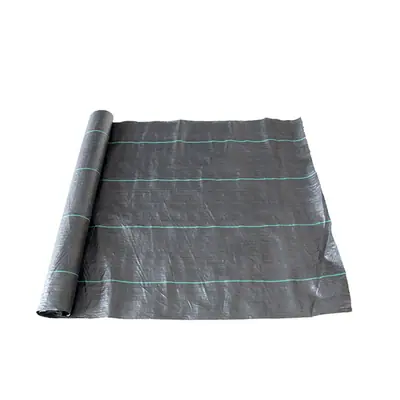
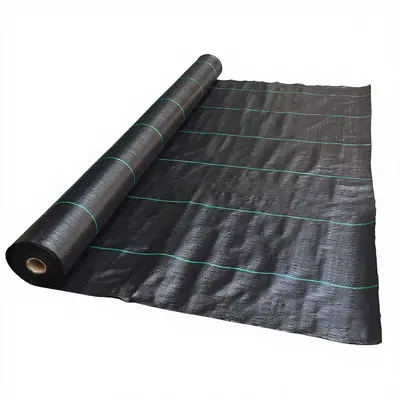
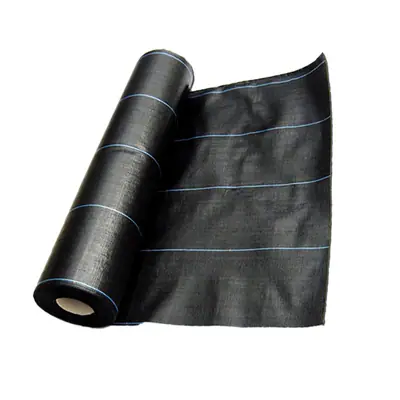
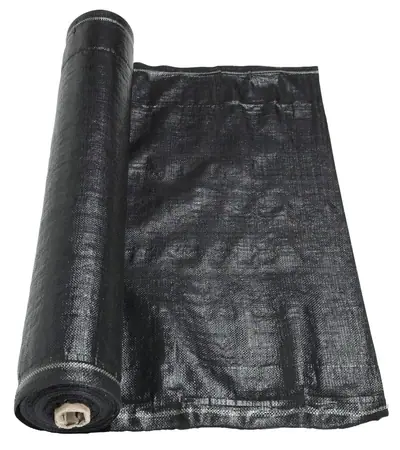
Use woven slit-film geotextile, often called woven geofabric. Its high strength and low stretch are what you want under loads. Non-woven can be used under driveways on firm, sandy soils, but it stretches more and is generally more expensive for the same job.
| Subgrade condition | Fabric | Overlap | Base thickness (typical) |
|---|---|---|---|
| Firm, well-drained (sand, gravel) | Woven, light separation grade | 12 in (30 cm) | 4–6 in (10–15 cm) |
| Average (firm clay, loam) | Woven, ~200 lb grab tensile | 18 in (45 cm) | 6–8 in (15–20 cm) |
| Soft (wet clay, silt) | Woven, heavy stabilization grade | 24–36 in (60–90 cm) | 8–12 in (20–30 cm) |
| Very soft, organic, peat | Engineer design; geogrid + geotextile | 36 in+ | Design-specific |
Thicknesses assume passenger cars and occasional light trucks. Driveways for heavy trucks, RVs or equipment need a thicker base.
Driveway layers
| Layer, top to bottom | Depth | Material |
|---|---|---|
| Surface gravel | 2–3 in (5–7.5 cm) | 3/8–3/4 in crushed stone, or crushed stone with fines |
| Base course | 4–8 in (10–20 cm) | Dense-graded crushed stone (1.5 in down to fines), compacted |
| Woven geotextile | — | Rolled flat, overlapped and pinned |
| Subgrade | — | Native soil, topsoil removed, graded and compacted |
Build tips
- Crown or cross-slope the subgrade at about 2% so water runs off the driveway, and add side ditches on flat sites.
- Lay fabric in the direction of traffic. Shingle the overlaps so stone is pushed over the joint, not into it.
- Back-dump stone from the truck onto the fabric and spread forward. Do not drive on bare fabric.
- Compact in lifts of about 4 in (10 cm).
- Wrap the edges up into the side of the stone layer, or extend fabric 12 in beyond the stone, to stop soil creeping in from the shoulders.
How much fabric and stone?
Fabric area = (driveway width + 2 ft edge allowance) × length × 1.1 for overlaps
Stone (yd³) = length (ft) × width (ft) × depth (in) ÷ 324
Worked example: a driveway 100 ft long and 12 ft wide on average clay, with a 6 in base and 2 in surface:
- Fabric: (12 + 2) × 100 × 1.1 = 1,540 ft² ≈ 143 m²
- Base stone: 100 × 12 × 6 ÷ 324 = 22.2 yd³ (about 17 m³)
- Surface gravel: 100 × 12 × 2 ÷ 324 = 7.4 yd³ (about 5.7 m³)
At roughly 1.4 tons per cubic yard of compacted crushed stone, that is about 31 tons of base and 10 tons of surface stone. Check the supplier's conversion for your material.
For garden paths and patios, the lighter approach in landscape fabric under gravel, pavers and rock is enough.
Geotextile for a French drain
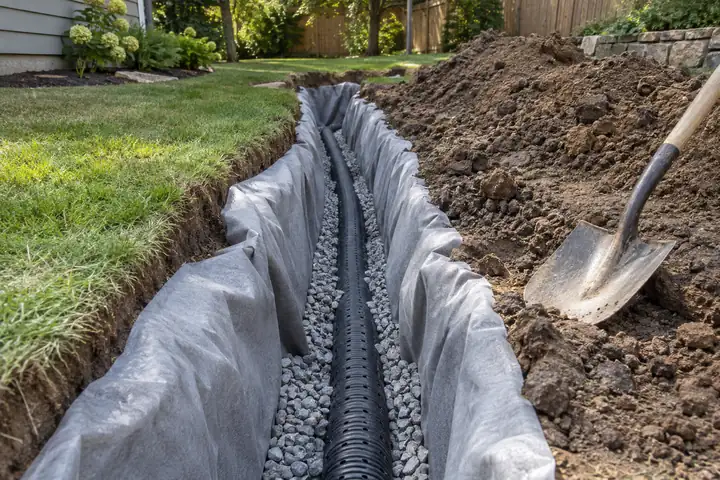
A French drain is a gravel-filled trench, usually with a perforated pipe, that collects and redirects groundwater or surface water. The fabric's job is filtration: keep surrounding soil out of the gravel so the drain does not silt up.
Non woven geotextile for French drain
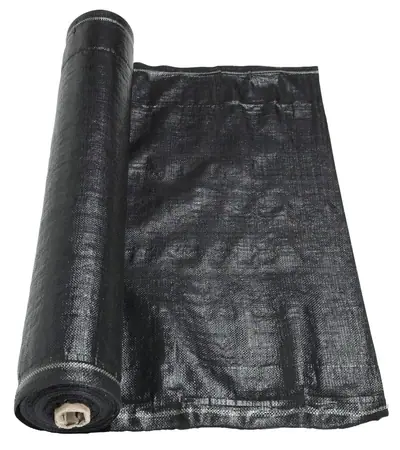
Use a non-woven needle-punched geotextile, commonly 4–6 oz/yd² (about 135–200 g/m²). Its high flow rate and fine pore structure let water in and hold silt and sand back.
Avoid:
- Woven slit-film fabric: it passes much less water and fine soil can blind it.
- Thin spunbond landscape fabric for French drain trenches: it tears during backfill and can clog. Landscape fabric is the most common cause of failed DIY drains.
- Solid plastic: blocks the water entirely.
French drain build-up
| Element | Typical spec |
|---|---|
| Trench width | 6–12 in (15–30 cm) |
| Trench depth | 18–24 in (45–60 cm) for yard drains; deeper for foundation drains |
| Slope | At least 1% (about 1/8 in per foot); 2% is better |
| Fabric | Non-woven geotextile drainage fabric lining the trench, with enough extra to overlap 12 in on top |
| Bedding | 2–3 in of washed stone under the pipe |
| Pipe | 4 in (100 mm) perforated, holes facing down |
| Fill | Washed 3/4–1.5 in (20–40 mm) clean stone, no fines |
| Top | Fabric folded over the stone, then soil and turf or decorative gravel |
Fabric width = trench width + 2 × depth + 12 in overlap. For a 12 in wide × 24 in deep trench: 12 + 48 + 12 = 72 in, so a 6 ft (1.8 m) wide roll.
Use clean, washed stone. Stone with fines will clog the drain from the inside regardless of fabric.
Geotextile fabric for retaining walls
Landscape fabric retaining wall details
In a segmental retaining wall (SRW) built from interlocking concrete blocks, fabric has one job: keep the backfill soil out of the drainage stone behind the blocks. This fabric is often called SRW fabric.
| Zone | Material | Width / depth |
|---|---|---|
| Wall blocks | Segmental units | Per manufacturer |
| Drainage zone | Clean 3/4 in crushed stone, behind and between block cores | At least 12 in (30 cm) behind the wall |
| Drain pipe | 4 in perforated, at the base of the drainage zone, outlet to daylight | — |
| Separation fabric | Non-woven geotextile between drainage stone and retained soil | Full height of wall |
| Retained soil | Compacted backfill | — |
| Leveling pad | 6 in (15 cm) compacted crushed stone | Wider than the wall base |
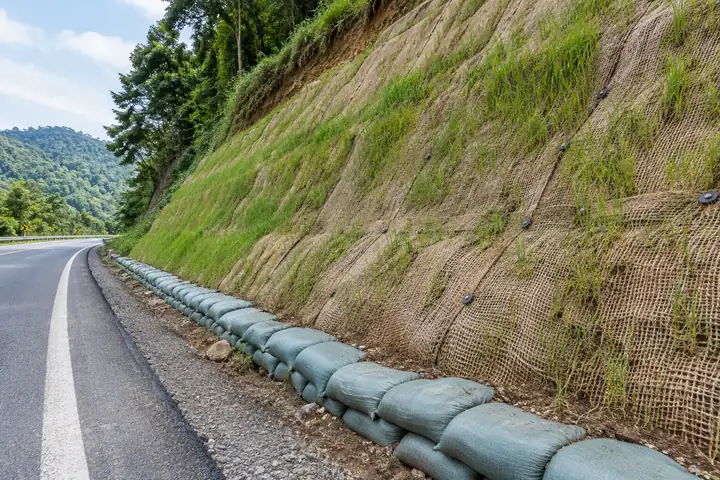
Place geotextile fabric for the retaining wall vertically against the excavated soil face, then fold it over the top of the drainage stone below the final soil cap. This stops soil migrating into the stone and keeps water draining freely, which reduces water pressure behind the wall.
Geogrid is not geotextile
Taller walls (often over about 3–4 ft / 1–1.2 m, or lower with slopes or loads above) need geogrid layers extending back into the retained soil to tie the wall together. Geogrid is a stiff, open grid designed for tensile reinforcement. Do not substitute fabric for geogrid, and follow the block maker's design charts or an engineer's design for any wall that retains significant height or supports driveways, buildings or slopes.
Timber and rock walls
Behind timber sleeper and dry-stone walls, line the back of the wall with non-woven fabric before backfilling with drainage stone. Fabric with a high flow rate prevents soil washing through gaps.
Soil stabilization fabric for work areas
Temporary site roads, laydown yards and crane pads over soft ground use heavy woven geotextile to spread loads and reduce aggregate loss. Heavy woven polypropylene mats, such as PP Weed Control Mat High Load Capacity for Construction and Reinforced PP Weed Mat with Tear-Resistant Construction, are used under aggregate on industrial yards. Where a permeable surface is needed, Industrial PP Weed Control Mat with Permeable combines strength and drainage. For engineered roads, confirm the fabric's tested properties against the project specification.
Common mistakes
- Using landscape fabric in a French drain. It clogs.
- Using non-woven fabric where it will be driven on directly. It stretches and tears.
- Short overlaps on soft ground. Overlaps pull apart under load; go 24–36 in.
- Driving on bare fabric. Always keep at least 6 in of stone between tires and fabric.
- Skipping the outlet. A French drain or wall drain needs somewhere to discharge.
Supply for contractors and distributors
EGP manufactures woven polypropylene fabrics in Yantai, China, in custom widths and roll lengths for contractors, landscape suppliers and importers. We do not make needle-punched non-woven geotextile; for drains, source a non-woven from a geosynthetics supplier. Browse Woven Rolls & Weed Mat or request a quote for woven grades.
Frequently asked questions
Do I need geotextile fabric under a gravel driveway?
On clay, silt or any soft or wet soil, yes; it stops the stone sinking and greatly extends the driveway's life. On firm sand or gravel it is less critical but still reduces stone loss.
Is woven or non-woven better for a driveway?
Woven is generally better because it is stronger and stretches less under wheel loads. Non-woven is the better choice for drains and anywhere water must pass through quickly.
Can I use landscape fabric for a French drain?
It is not recommended. Thin landscape fabric clogs and tears; use a non-woven geotextile drainage fabric of about 4–6 oz/yd².
Do retaining walls need fabric behind them?
Most segmental and timber walls benefit from a non-woven fabric between the drainage stone and the retained soil. Taller walls also need geogrid reinforcement designed for the wall.
How much should geotextile fabric overlap?
About 12 in (30 cm) on firm soils, 18 in on average soils and 24–36 in (60–90 cm) on soft soils. Overlap in the direction stone will be spread.
What is driveway fabric?
Driveway fabric (also called road fabric) is a woven geotextile laid between the subgrade soil and the gravel. It separates the layers so stone does not sink into mud, spreads wheel loads and reduces ruts and potholes.