Key takeaways
- Yes, use fabric under gravel in most cases: it stops stone sinking and weeds rising from the soil.
- Use woven fabric of 100 g/m² (about 3 oz/yd²) or more; thin spunbond tears under sharp stone.
- Keep pea gravel to 2–3 in deep and use solid edging so it stays put.
- Under pavers, fabric goes below the crushed-stone base, not between sand and pavers.
- Playgrounds need fabric under loose fill 9–12 in deep, per common safety guidance.
Yes, you should use landscape fabric under gravel in most situations. A woven fabric of at least 100 g/m² (about 3 oz per square yard) laid between the soil and the stone stops gravel from sinking into the ground, stops soil from working up into the stone, and blocks weeds growing from below. Use heavier fabric under sharp or large rock, keep the gravel layer 2–3 inches deep, and expect to remove occasional weeds that sprout from windblown seed on top.
This guide covers the fabric to choose and how to build gravel paths, rock gardens, river rock beds, paver patios and play areas.
Should I use landscape fabric under gravel?
Fabric earns its place under gravel for two reasons:
- Separation. Without a barrier, gravel is pushed into the soil by feet and rain, and mud pumps up into the stone. After a few seasons you have a muddy path and need more gravel.
- Weed suppression from below. Weed seeds in the soil cannot reach light.
Fabric does not stop seeds landing on top. Dust and leaves collect between stones and form a thin growing layer over time. Rake leaves off, keep the gravel layer deep enough, and pull seedlings early.
When you might skip it
- Driveways and roads with a deep compacted base on firm ground may use a geotextile only where the subgrade is soft. See geotextile fabric for driveways.
- Gravel gardens planted with self-seeding plants, where you want plants to spread.
- Very small, decorative areas where you prefer to top up and weed.
Which landscape fabric to use under gravel and rock
Sharp, angular stone and foot traffic punch holes in light fabric. Choose by stone size and load:
| Cover | Stone size | Fabric | Approx. weight |
|---|---|---|---|
| Pea gravel path | 3/8 in (10 mm), rounded | Woven PP | 100 g/m² (3 oz/yd²) |
| Crushed gravel path | 3/8–3/4 in (10–20 mm), angular | Woven PP | 100–130 g/m² (3–3.8 oz/yd²) |
| River rock bed | 1–3 in (25–75 mm), rounded | Heavy woven PP | 130 g/m² and up |
| Rock garden, boulders | 3 in+ (75 mm+) | Heavy woven PP, extra layer under boulders | 130–200 g/m² |
| Paver patio base | Crushed stone base | Woven geotextile | Separation grade |
| Equipment and vehicle areas | Crushed aggregate | High-load woven PP | 150 g/m² and up |
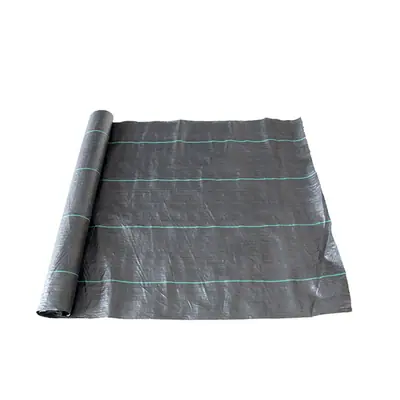
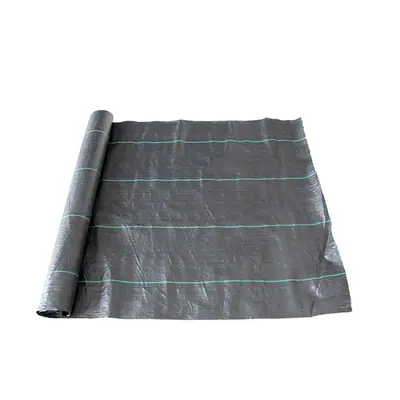
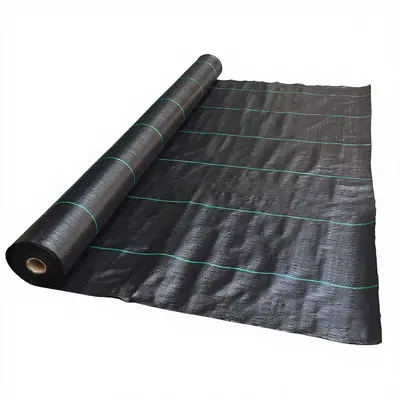
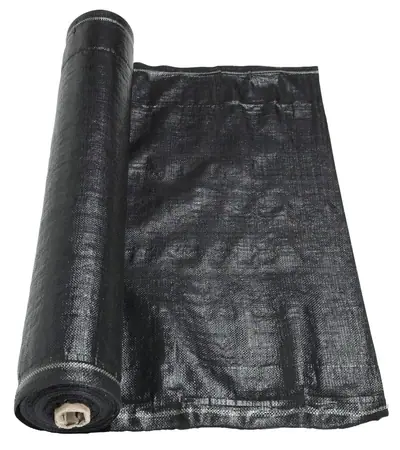
Heavy duty landscape fabric for gravel is almost always woven. Spunbond garden fabric tears under angular stone and when raked. Our Heavy Weight PP Weed Control Fabric with Enhanced suits most paths and rock beds, and the Reinforced PP Weed Mat with Tear-Resistant Construction is made for heavier industrial yards. The heavy duty landscape fabric guide explains weights in more detail.
Landscape fabric for a gravel path
Recommended layers
| Layer | Depth |
|---|---|
| Top gravel (pea gravel or 3/8 in crushed) | 2–3 in (5–7.5 cm) |
| Optional compacted base (crushed stone with fines) for heavy use | 2–4 in (5–10 cm) |
| Woven landscape fabric | — |
| Compacted subgrade soil | — |
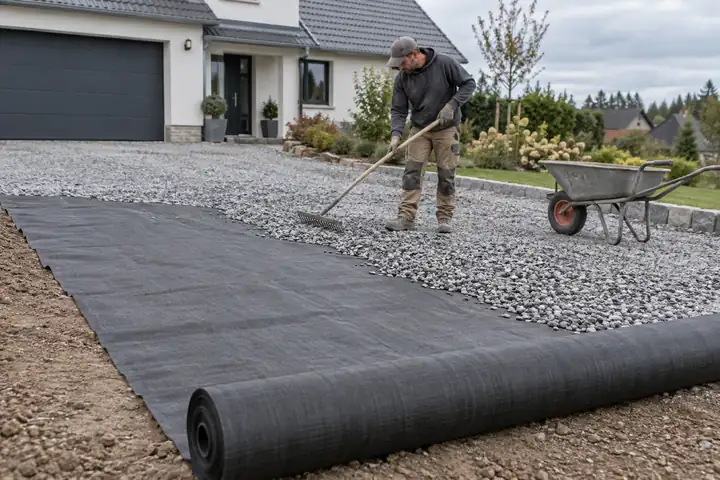
When choosing landscape fabric for gravel path projects, the main question is traffic. For light garden paths, gravel directly over fabric is fine. For paths that carry wheelbarrows or mowers, add a compacted base under the top gravel; the fabric then goes under the base.
How much gravel?
Cubic yards = length (ft) × width (ft) × depth (in) ÷ 324
Worked example: a path 40 ft long, 3 ft wide, 2.5 in deep: 40 × 3 × 2.5 ÷ 324 = 0.93 cubic yards, roughly 1.3–1.4 US tons of gravel at about 1.4 t/yd³. In metric, 12.2 m × 0.9 m × 0.065 m ≈ 0.71 m³.
Order 10% extra for settling and spreading.
Landscape fabric for pea gravel
Pea gravel is round and rolls, which makes it comfortable but mobile. Three tips:
- Keep it shallow, 2 in (5 cm) is enough on a path. Deeper pea gravel is like walking on marbles.
- Use solid edging at least 1 in higher than the gravel surface.
- Consider a stabilizing grid (plastic honeycomb panels) on top of the fabric for paths that carry wheels.
Rounded stone is gentle on fabric, so a 100 g/m² woven fabric is usually enough.
Landscape fabric for river rock and rock gardens
River rock and larger landscape stone are heavy and often dropped from height or a wheelbarrow. To protect the fabric:
- Use a heavier woven grade and double it under large boulders, or set boulders on a pad of fabric scraps.
- Place stone by hand rather than tipping it from height.
- Overlap seams by at least 12 in so rock movement does not open gaps.
- Cut planting pockets with an X, fold the flaps under, and backfill planting holes with soil only inside the pocket.
In a rock garden with alpine plants, many growers lay fabric only between planting pockets and use a thick grit mulch on top.
Weed barrier for pavers: where does the fabric go?
For a paver patio or walkway, the fabric is a separation layer under the crushed-stone base, on top of the compacted soil. It is not a weed barrier between the bedding sand and the pavers, and ordinary thin landscape fabric for pavers is the wrong product: use a woven separation grade.
| Layer, top to bottom | Typical depth for a patio |
|---|---|
| Pavers | 2 3/8 in (60 mm) |
| Bedding sand | 1 in (25 mm) |
| Compacted crushed-stone base | 4–6 in (10–15 cm) for foot traffic; 8–12 in (20–30 cm) for driveways |
| Woven geotextile fabric under pavers | — |
| Compacted subgrade | — |
Weeds in paver joints grow from seeds blown into the joints, not from the soil below. Polymeric joint sand and a well-compacted base are what control them. A geotextile fabric under pavers keeps the base from mixing with clay soil, which is what causes pavers to sink over time. In wet or clay soils, a woven separation geotextile is strongly recommended. For the difference between geotextile and landscape fabric, see geotextile fabric: woven vs non-woven.
A small strip of fabric is sometimes placed along the inside of edge restraints to stop bedding sand washing out through gaps; that is optional.
Landscape fabric for playgrounds
Loose-fill surfacing under play equipment (wood chips, engineered wood fiber, pea gravel or rubber mulch) needs a fabric underneath for the same reasons as a path, plus drainage.
- Common safety guidance calls for loose fill 9–12 in (23–30 cm) deep under equipment; check the requirements that apply in your country and the equipment maker's fall-height data.
- Use a permeable woven fabric so the play area drains fast.
- Do not leave fabric edges exposed where children dig; bury edges or fix them under a timber border.
- Pin with plastic stakes or bend metal staples fully flush.
Ground cover ideas for a play area
| Option | Pros | Cons |
|---|---|---|
| Engineered wood fiber over fabric | Good cushioning, accessible when compacted | Needs topping up |
| Wood chips over fabric | Low cost | Breaks down, can splinter |
| Pea gravel over fabric | Long-lasting, drains well | Gets thrown and carried; harder to walk on |
| Rubber mulch over fabric | Long-lasting cushion | Higher cost; gets hot |
| Rubber tiles or poured surface | Accessible, clean | Highest cost; professional install |
| Grass | Natural | Wears bare under swings; little cushioning when dry |
Alternative to landscape fabric under gravel
If you want to avoid fabric, options include:
- A compacted base of crushed stone with fines (often called road base or crusher run), 3–4 in deep, under the top gravel. This resists both weeds and sinking reasonably well.
- Plastic gravel stabilizer grids filled with gravel, sometimes with a thin fabric bonded to the bottom.
- Cardboard under a temporary path, which breaks down within a season.
- Thicker gravel (4 in) with periodic weeding.
Solid black plastic under gravel is not recommended: water pools on it, and gravel slides around.
Installation summary
The steps above in the how-to list follow the same method as our general how to lay landscape fabric guide, with two gravel-specific rules: never drag stone across the fabric with a rake tine, and dump gravel in piles on the fabric and spread it outward so you are not walking or wheeling directly on exposed fabric.
Buying for projects and resale
EGP manufactures woven polypropylene fabric in custom widths and roll lengths for contractors, landscape suppliers and distributors, including high-load grades such as PP Weed Control Mat High Load Capacity for Construction. See Woven Rolls & Weed Mat or request a quote.
Frequently asked questions
What is the best landscape fabric under gravel?
A woven polypropylene fabric of at least 100 g/m² (about 3 oz/yd²). Go heavier, 130 g/m² or more, under angular crushed stone, river rock or any area with wheels.
How deep should pea gravel be over landscape fabric?
About 2 in (5 cm) for paths and up to 3 in for beds. Deeper pea gravel shifts underfoot and is harder to walk on.
Do you need landscape fabric under pavers?
A woven geotextile under the crushed-stone base is recommended, especially on clay or wet soil, because it stops the base mixing into the subgrade. It does not stop weeds in the joints; polymeric sand does that.
Will weeds grow through gravel with landscape fabric?
Few weeds grow up through the fabric, but seeds that blow into the gravel can sprout on top. Rake off leaves and pull seedlings early to keep the path clean.
Is landscape fabric needed for a playground?
It is strongly recommended under loose fill because it keeps the surfacing from mixing with soil and helps drainage. Keep the edges buried so children cannot pull it up.