Key takeaways
- Start from bulk density and fill weight, not from a catalogue size.
- Volume (m³) = fill weight (t) ÷ bulk density (t/m³); then pick a base that fits your pallet.
- Spout top + spout bottom for powders on filling lines; open top + flat bottom for firewood, aggregates and manual filling.
- Add a liner for moisture-sensitive or fine powders, baffles to keep a square shape.
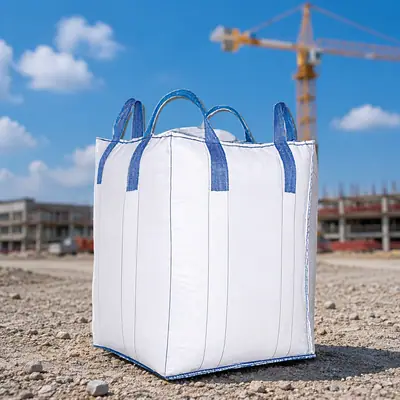
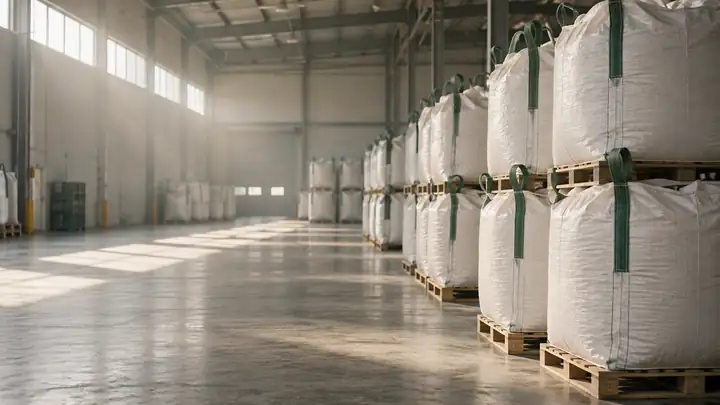
There is no universal "standard" jumbo bag. A good FIBC is designed around three things: the product inside it, the way it is filled and the way it is emptied. Specify those clearly and the right bag almost designs itself.
Step 1: Know your product
Before anything else, write down:
- Bulk density in t/m³ (or kg/l). Flour is roughly 0.5–0.6, cement around 1.2–1.4, dry sand about 1.5–1.6, wood chips 0.2–0.3. Use your own measured value where possible.
- Particle size and flow. Fine powders sift through fabric and seams; coarse or sharp materials abrade.
- Moisture sensitivity. Hygroscopic products such as fertiliser, sugar and cement need a barrier.
- Ignition risk. Combustible dusts or flammable atmospheres need anti-static bag types.
- Food or pharmaceutical contact, which requires clean-room or food-grade production.
Step 2: Set the fill weight and safety factor
The fill weight becomes the safe working load (SWL). Most bags are rated 500–2,000 kg. Choose 5:1 for single-trip use or 6:1 for reusable bags; our FIBC safety factor guide explains the difference.
Step 3: Calculate the dimensions
Required volume is simple arithmetic:
Volume (m³) = fill weight (t) ÷ bulk density (t/m³)
For 1 tonne of a product at 0.8 t/m³ you need about 1.25 m³. A filled FIBC bulges, so its usable volume is a little less than the geometric box. As a rule of thumb, choose a base that suits your pallet — 90 × 90 cm or 95 × 95 cm on a 100 × 120 cm pallet — and then set the height so that base × height gives roughly 10–15% more than the calculated volume.
| Product (example) | Bulk density | Fill weight | Typical size (cm) |
|---|---|---|---|
| Wood chips / firewood | 0.25–0.4 | 300–500 kg | 90 × 90 × 120 to 100 × 100 × 150 |
| Grain, feed pellets | 0.6–0.75 | 1,000 kg | 90 × 90 × 150 to 95 × 95 × 160 |
| Fertiliser | 0.9–1.1 | 1,000 kg | 90 × 90 × 120 |
| Cement, sand | 1.3–1.6 | 1,000–1,500 kg | 90 × 90 × 90 to 90 × 90 × 110 |
These are starting points; always confirm with a trial fill.
Step 4: Choose the body construction
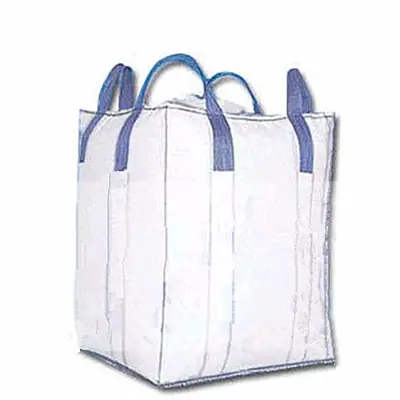
- U-panel: two pieces of fabric form a U, closed by two side panels. Strong, keeps its shape well and suits heavier loads.
- Four-panel: four side panels sewn together; good squareness.
- Tubular (circular): woven as a tube with no vertical seams, so fewer sifting points — preferred for fine powders.
- Baffle (Q-bag): internal fabric baffles across the corners keep the bag square when full, so it uses up to about 25–30% more container and warehouse space. See our FIBC Virgin PP Breathable Tubular Jumbo Bulk Baffle.
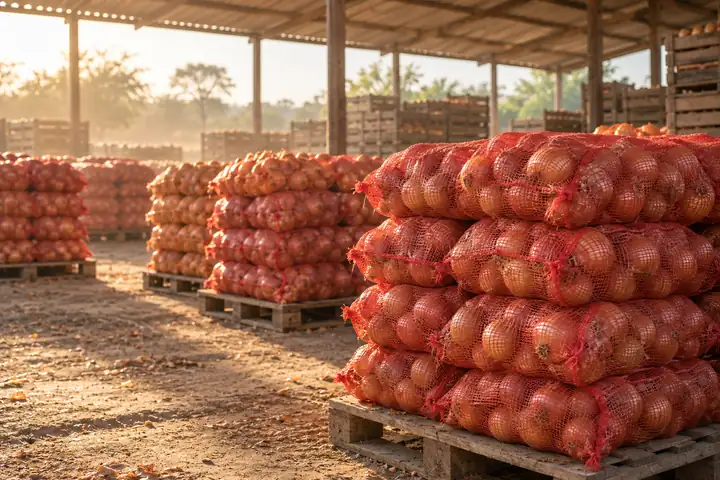
- Vented: mesh panels for firewood, potatoes and onions that must breathe.
Step 5: Choose the top (filling)
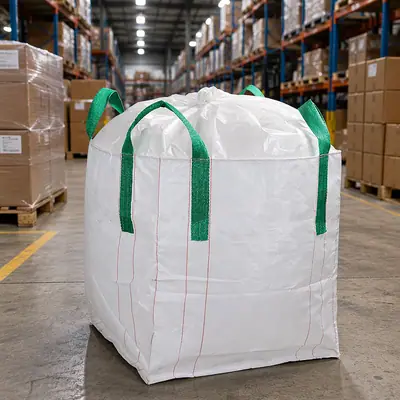
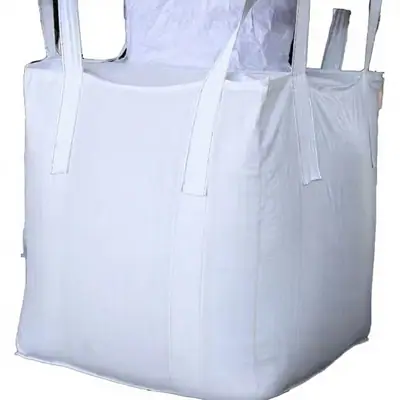
- Full open top — fastest for manual or grab filling of aggregates and firewood.
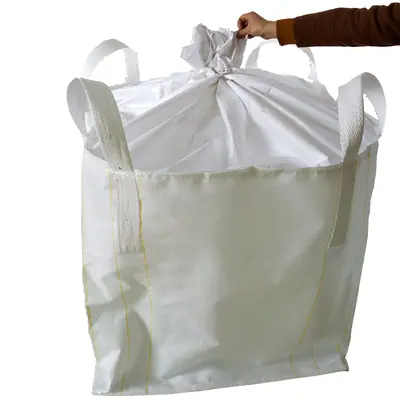
- Duffle / skirt top — a fabric skirt that can be gathered and tied; protects contents and fits wide filling heads.
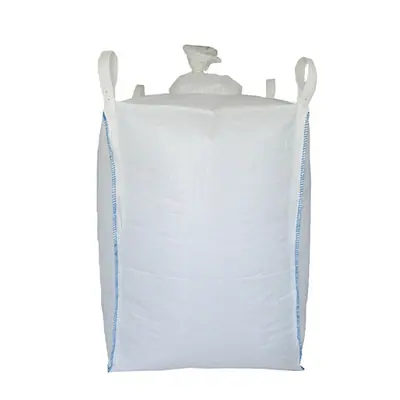
- Filling spout — a sleeve (often 35–45 cm diameter) that seals to the filling head of an automatic line; best for powders and dust control.
Step 6: Choose the bottom (discharge)
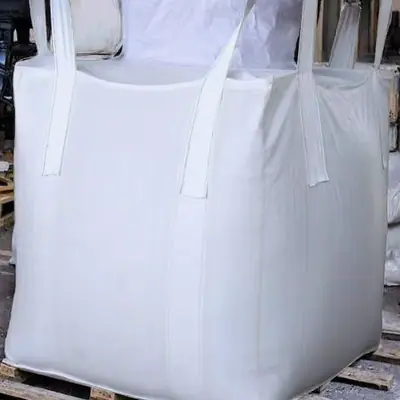
- Flat bottom — the bag is cut open or tipped to empty; lowest cost, used for single-trip one-way loads.
- Discharge spout — a sleeve with a closure flap (often a "star" or petal closure) for controlled emptying into hoppers; essential for powders and granulates. Our Large Capacity Jumbo Bag Integrated Discharge Outlet is an example.
Step 7: Choose loops and extras
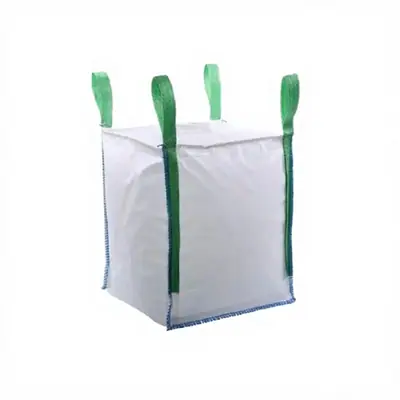
Loops. Cross-corner loops are sewn across each corner and are the most common choice for forklift handling. Side-seam loops are sewn into the vertical seams. Single- or two-loop designs suit crane hooks and high-volume mineral packing.
Liners. A polyethylene liner — loose, sewn-in or form-fit — protects moisture-sensitive or fine products and keeps food grades clean.
Coatings and UV. Coated fabric stops sifting and moisture; uncoated fabric breathes. Add UV stabilisation for any outdoor storage.
Printing. One or two sides, with your logo, product, SWL, safety factor and handling instructions.
Our recommendation
If you are unsure, start with a U-panel, 1,000 kg SWL, 5:1, 90 × 90 cm base, duffle top and discharge spout, cross-corner loops, coated fabric with PE liner for powders — or an open-top, flat-bottom, uncoated or vented bag for coarse materials. Then fine-tune after a trial fill. Compare options in our FIBC Bulk Bags range or send your product data and we will propose a drawing.
Frequently asked questions
What is the most common jumbo bag size?
For a 1,000 kg bag of medium-density product, 90 × 90 × 110–120 cm is the most common size because it fits standard pallets and containers well. The right height depends on your bulk density.
Do I need a liner?
Use a liner if the product is fine enough to sift through seams, absorbs moisture or must meet food-hygiene requirements. Coarse, dry, non-food products usually do not need one.
What is the difference between a U-panel and a tubular bag?
A U-panel bag has vertical seams and holds a square shape well; a tubular bag is woven as a seamless tube, which reduces sifting of fine powders.
Can I get a drawing before ordering?
Yes. We provide a dimensioned drawing and specification sheet for approval, followed by a sample if required.