Key takeaways
- Firewood ships in two formats: mesh net sacks (about 20–80 L) for retail and vented bulk bags (about 1–2 m³) for delivery to homes and dealers.
- Loose, thrown logs take roughly 1.4–1.5× the space of the same wood stacked, so a 1/3 cord bag needs about 1.7 m³ of loose volume — e.g., 110 × 110 × 140 cm.
- Vented fabric lets wood keep drying and stops mould; UV stabilisation matters for yard storage.
- Pick a safe working load with margin: a 1.7 m³ bag of seasoned hardwood often weighs 500–700 kg, green wood much more.
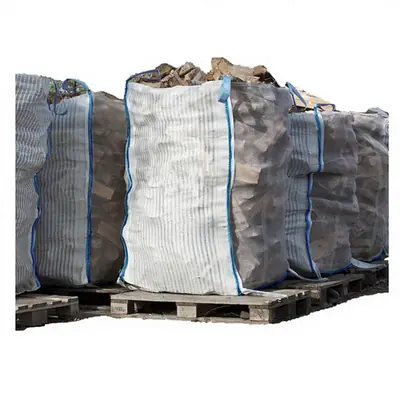
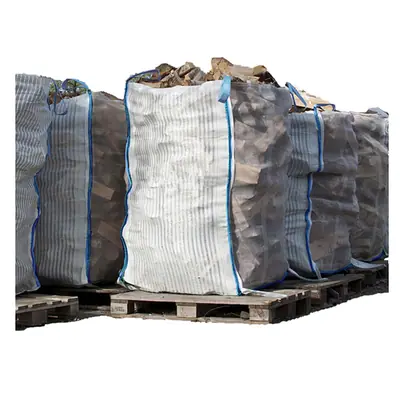
Firewood bags come in two main formats. Small mesh firewood bags (net sacks for logs, roughly 20–80 litres) are used for retail sales at gas stations, garden centres and convenience stores. Vented bulk bags — FIBCs with mesh or ventilated panels holding about 1–2 m³ — are used to season, store and deliver larger loads such as 1/3 cord. Both use breathable polypropylene so the wood keeps drying instead of going mouldy.
This guide explains how to size firewood bags, how cords convert to bag volumes and what to check before buying firewood bags in bulk.
Mesh firewood bags for retail
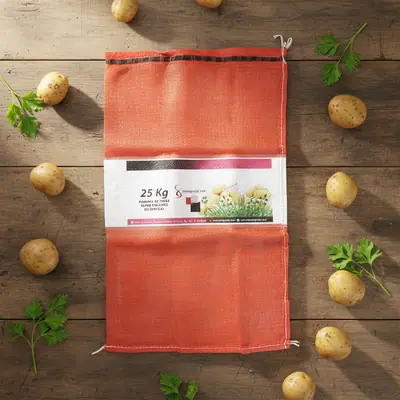
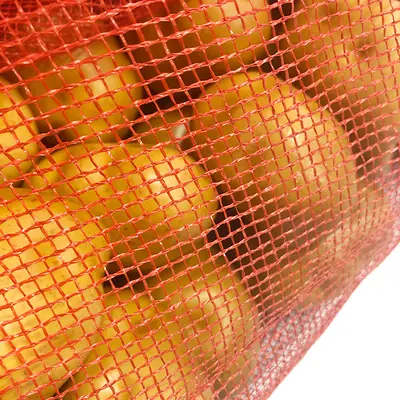
Mesh firewood bags are open-weave leno or knitted raschel sacks, usually with a drawstring and a printed label. They are filled with kiln-dried logs, kindling or wood briquettes and sold by volume.
| Bag | Approx. flat size | Approx. volume | Typical contents |
|---|---|---|---|
| Kindling sack | 30 × 50 cm (12 × 20 in) | 8–12 L | Kindling sticks, fire starters |
| Small log sack | 40 × 60 cm (16 × 24 in) | 20–25 L | Retail log bundle, camping wood |
| Standard log sack | 45 × 70 cm (18 × 28 in) | 30–40 L | Kiln-dried logs for retail |
| Large log sack | 50 × 80 cm (20 × 32 in) | 40–50 L | Value packs, kiln-dried hardwood |
| Extra-large | 60 × 90 cm (24 × 36 in) | 60–80 L | Garden-centre bulk sacks |
Filled volume depends heavily on log length and how the bag is packed, so measure a filled bag before you print a volume claim. Retail bundles in North America are often around 0.75 cu ft (about 21 L) of wood.
Why mesh? Air flows through the logs, so kiln-dried wood stays dry and any residual moisture can escape. Buyers can see the quality of the wood. Bags are light (often 25–50 g) and cheap per unit. Woven leno bags such as our 20-50kg Yellow Woven PP Leno Mesh Bags for Agriculture are stiff and stack well; knitted raschel bags stretch around irregular logs. The differences are explained in our mesh bags guide.
What to specify for net sacks for logs
- Size and bag weight: heavier bags resist splinters and sharp ends; 40–50 L log sacks commonly use bags of 35–50 g.
- Mesh opening: small enough that kindling and bark do not fall through.
- Drawstring for quick closing on filling stands.
- Label strip printed with brand, species, volume and moisture claim.
- UV stabiliser if filled bags are displayed outdoors.
Vented bulk bags for firewood
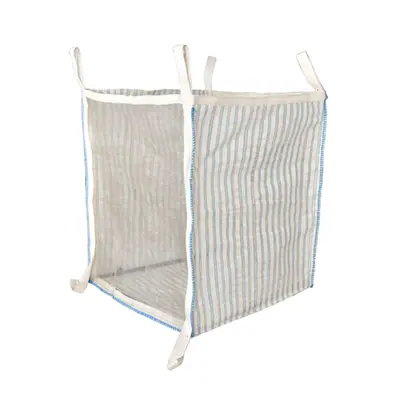
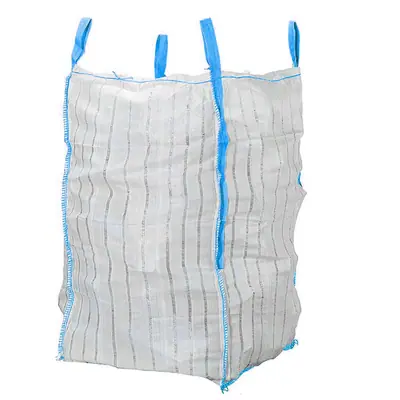
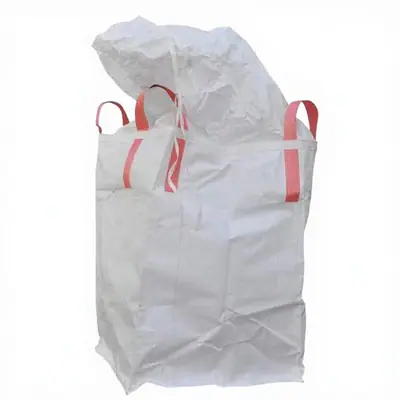
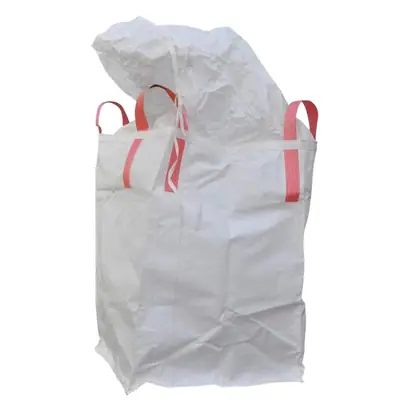
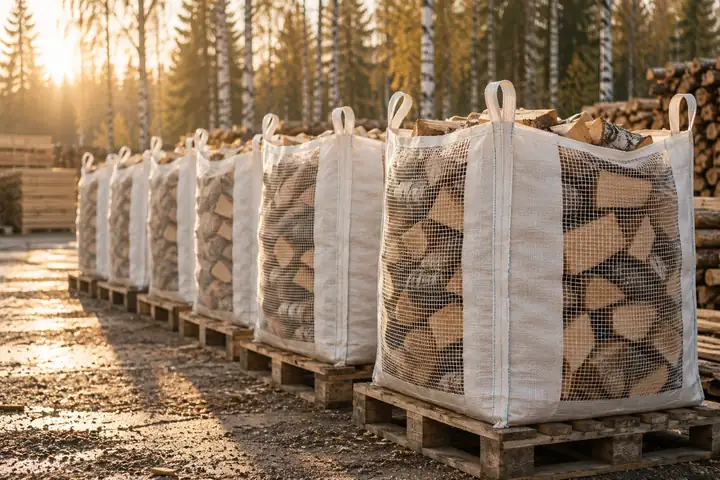
For larger quantities, firewood sellers use ventilated bulk bags, also called vented bulk bags or big bag firewood sacks. These are FIBCs built from woven polypropylene with breathable or mesh panels:
- Open top (often with a skirt or no closure) for loading from a conveyor or by hand
- Flat bottom so the bag stands and stacks on a pallet or yard
- Four lifting loops for forklift tines or a crane hook
- Vented side panels — full mesh, mesh strips or breathable uncoated fabric
- UV stabilisation for months of yard storage
Firewood is often loaded green or part-seasoned into vented bags and left in the yard or a drying shed. The bag holds a fixed, sellable volume and lets air through on all sides. Our Vented Firewood Bag PP Firewood Bulk Bag has full mesh side panels, while the 4 Loops Firewood FIBC Bags 1000KG 1500KG PP Woven uses breathable woven fabric with higher load ratings. You can see a typical setup in our vented firewood bulk bags project.
Cord, stere and bag volume: the conversions
Firewood is traded in stacked volume, while bags are measured in loose (thrown) volume. Mixing the two is the most common sizing mistake.
- 1 cord = 4 × 4 × 8 ft stacked = 128 cu ft = 3.62 m³ stacked
- 1/3 cord = 42.7 cu ft = 1.21 m³ stacked
- 1 stere (Europe) = 1 m³ of stacked wood
- Loose to stacked: thrown logs typically occupy about 1.4–1.5× the volume of the same wood neatly stacked. The exact factor varies with log length, splitting and how the bag is filled.
Worked example: sizing a 1/3 cord firewood bag
- 1/3 cord stacked = 1.21 m³.
- Loose volume needed ≈ 1.21 × 1.4 = 1.69 m³ (up to 1.81 m³ at 1.5×).
- A bag of 110 × 110 × 140 cm = 1.10 × 1.10 × 1.40 = 1.69 m³.
So a 1/3 cord firewood bag is commonly around 110 × 110 × 140 cm, or a slightly taller body if your logs pack loosely. Always verify by stacking the contents of a filled bag and measuring.
Common firewood bulk bag sizes
| Bag (W × D × H) | Loose volume | Approx. stacked equivalent | Approx. fraction of a cord |
|---|---|---|---|
| 90 × 90 × 120 cm (35 × 35 × 47 in) | 0.97 m³ | 0.65–0.70 m³ (23–25 cu ft) | about 1/5 |
| 100 × 100 × 100 cm (39 × 39 × 39 in) | 1.00 m³ | 0.67–0.71 m³ (24–25 cu ft) | about 1/5 |
| 100 × 100 × 150 cm (39 × 39 × 59 in) | 1.50 m³ | 1.00–1.07 m³ (35–38 cu ft) | about 0.3 |
| 110 × 110 × 140 cm (43 × 43 × 55 in) | 1.69 m³ | 1.13–1.21 m³ (40–43 cu ft) | about 1/3 |
| 120 × 120 × 150 cm (47 × 47 × 59 in) | 2.16 m³ | 1.44–1.54 m³ (51–54 cu ft) | about 0.4 |
In many jurisdictions, firewood must be sold by stacked measure (cords and fractions of a cord, or steres/m³) and terms like "face cord" or "rick" may not be accepted. Check your local weights-and-measures rules before you print a volume on the bag or advertise "1/3 cord".
How much does a bag of firewood weigh?
Weight drives the safe working load (SWL) you need. Typical ranges:
| Wood condition | Approx. loose bulk density | 1 m³ bag | 1.69 m³ (1/3 cord) bag |
|---|---|---|---|
| Kiln-dried softwood | 200–280 kg/m³ | 200–280 kg | 340–470 kg |
| Kiln-dried / seasoned hardwood | 300–400 kg/m³ | 300–400 kg | 500–680 kg |
| Green (freshly cut) hardwood | 450–550 kg/m³ | 450–550 kg | 760–930 kg |
These are rough figures; species, log size and moisture change them considerably. Choose a bag rated comfortably above the heaviest load you expect — for 1.5–2 m³ bags that will be filled with green hardwood, a 1,000–1,500 kg SWL is commonly used. Check the SWL and safety factor on the bag label, and never lift a bag beyond its rating. See FIBC safety factor 5:1 vs 6:1 for what those numbers mean.
Smaller operations delivering half-tonne loads can use bags such as our 0.5 Ton 1 Ton Breathable Ventilated PP Bulk Bag Firewood, rated 0.5–1 t.
Drying and storing firewood in bags
- Season before or in the bag. Firewood is generally considered ready to burn below about 20% moisture content. Vented bags let wood continue drying in the yard, but airflow is slower than an open stack in a windy spot.
- Cover the top. Rain falls straight into open-top bags; use a lid, cap or roofed storage.
- Raise bags off the ground on pallets to stop wicking and rot at the base.
- Space the bags so air can move between them.
- Protect from sun if not UV-stabilised. UV-stabilised fabric is strongly recommended for any bag stored outdoors for more than a few weeks.
- Follow firewood movement rules. Many regions restrict moving untreated firewood to prevent the spread of forest pests; heat-treated, certified wood is often required for transport across those boundaries.
Buying firewood bags wholesale
Firewood producers buying firewood bags wholesale or in bulk usually need both formats: mesh sacks for retail and vented bulk bags for home delivery. For a quote, send:
- Bag type (mesh sack or vented bulk bag) and dimensions
- Target volume (L, m³, or cord fraction) and log length
- Maximum fill weight and required SWL (bulk bags)
- Fabric: full mesh panels or breathable woven; UV level
- Loops, top and bottom style (bulk bags); drawstring and label (mesh sacks)
- Printing: brand, species, volume and contact details
- Quantity per size and annual volume
For general FIBC specification, see how to choose an FIBC bulk bag and our super sacks guide.
EGP manufactures mesh firewood bags and vented FIBC bulk bags in Yantai, Shandong, with 24 years as an Alibaba.com supplier and a 90.9% on-time dispatch record. Browse Mesh & Leno Bags and FIBC Bulk Bags, or send your requirements through our contact page.
Frequently asked questions
What size bulk bag holds 1/3 cord of firewood?
Because loose logs take about 1.4–1.5 times their stacked volume, a 1/3 cord (1.21 m³ stacked) needs about 1.7–1.8 m³ of loose bag volume. A bag of roughly 110 × 110 × 140 cm is a common choice; verify by stacking and measuring a filled bag.
Why use vented bulk bags for firewood?
Vented bulk bags let air pass through the wood, so it keeps drying and is less likely to go mouldy than in a solid bag. They also make a fixed, liftable unit that can be stored in the yard and delivered by forklift or crane truck.
How much does a bulk bag of firewood weigh?
A 1 m³ bag of seasoned hardwood often weighs around 300–400 kg, and a 1/3 cord bag around 500–700 kg. Green hardwood can be much heavier, so choose a bag with a safe working load comfortably above your heaviest fill.
What size are mesh firewood bags?
Common retail log sacks range from about 40 × 60 cm (20–25 L) to 60 × 90 cm (60–80 L), with 45 × 70 cm and 50 × 80 cm being popular. Measure filled volume with your own logs before printing a volume on the label.
Can firewood bags be reused?
Vented bulk bags are often reused for several deliveries if they are inspected for damaged loops, cuts and UV degradation before each lift. Retail mesh sacks are generally treated as one-way packaging.