Key takeaways
- FIBC types A, B, C and D describe electrostatic protection, defined in IEC 61340-4-4 — not strength or size.
- Type A: no protection; Type B: low breakdown-voltage fabric; Type C: conductive, must be grounded; Type D: static-dissipative, no grounding.
- Only Type C (grounded) or Type D belong where flammable vapors or gases may be present.
- UN certified bulk bags (codes 13H1–13H5) are a separate requirement for dangerous goods in transport.
There are four types of FIBC bags by electrostatic protection: Type A (no protection), Type B (fabric with low breakdown voltage that prevents the most energetic sparks), Type C (conductive fabric that must be connected to ground) and Type D (static-dissipative fabric that is safe without grounding). These types are defined in the international standard IEC 61340-4-4, and choosing the right one depends on whether your product is a combustible dust and whether flammable gases or vapors are present where the bag is filled or emptied.
Separately, bulk bags that carry dangerous goods in transport must be UN certified, marked with a code such as 13H1 or 13H3. Electrostatic type and UN certification are two different questions, and some applications need both.
FIBC full form: what are flexible intermediate bulk containers?
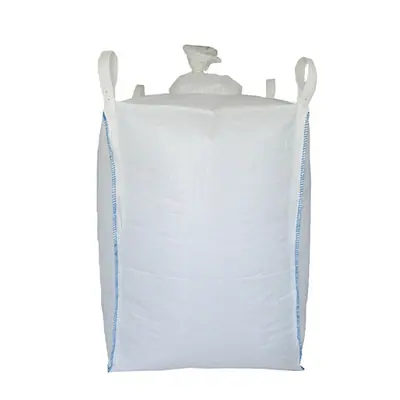
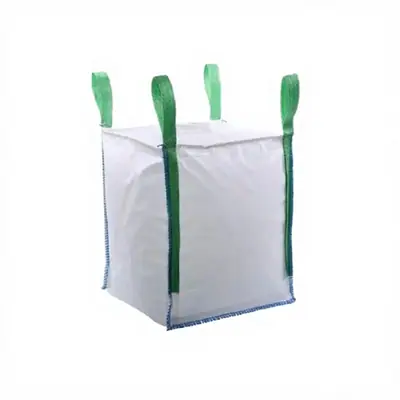
FIBC stands for flexible intermediate bulk container. "Intermediate" places it between small packages (25–50 kg sacks) and bulk transport (silos, tankers, hoppers). Flexible intermediate bulk containers are made of woven polypropylene and typically carry 500–2,000 kg of dry product. They are also called bulk bags, super sacks, ton bags and jumbo bags; our super sacks guide explains the naming.
The strength and testing of FIBCs for non-dangerous goods are covered by ISO 21898, which includes the top-lift test behind the 5:1 and 6:1 safety factors (see our safety factor guide). The electrostatic types are covered by IEC 61340-4-4.
Why does static electricity matter in bulk bags?
When powder or granules flow into or out of a bag, particles rub against the fabric and each other and build up an electrostatic charge. Woven polypropylene is an excellent insulator, so that charge has nowhere to go. It can then discharge as a spark. Three things decide whether that spark is dangerous:
- The product. Many organic and some inorganic powders (flour, sugar, starch, plastic powders, pigments, some metal powders) are combustible dusts. Each has a minimum ignition energy (MIE), measured in millijoules (mJ). The lower the MIE, the easier it ignites.
- The atmosphere. Flammable solvent vapors or gases have very low MIEs, often well under 1 mJ.
- The discharge type. Insulating fabric can produce propagating brush discharges, which can release enough energy to ignite many dusts. Types B, C and D are designed to prevent them.
What are the four FIBC types?
The table summarizes how the four types are commonly described under IEC 61340-4-4. Always confirm with your own risk assessment and the current edition of the standard.
| Type | How it works | Grounding | Combustible dust | Flammable gas or vapor present |
|---|---|---|---|---|
| A | Plain PP fabric, no protection | Not applicable | Not suitable (only non-flammable products; commonly limited to dusts with MIE above 1,000 mJ) | No |
| B | Fabric with breakdown voltage of 6 kV or less, prevents propagating brush discharges | Not applicable | Yes, for dusts with MIE above 3 mJ | No |
| C | Interconnected conductive threads in the fabric | Required during filling and discharge | Yes | Yes, in typical Zone 1/2 gas groups IIA and IIB, when grounded |
| D | Static-dissipative fabric that releases charge as harmless corona discharge | Not required | Yes | Yes, in typical gas groups IIA and IIB (MIE of 0.14 mJ and above) |
Atmospheres with very sensitive gases such as hydrogen or acetylene (group IIC) are generally outside these uses; consult a static-safety specialist.
Type A bulk bags
Type A bulk bags are standard woven PP bags with no electrostatic protection. They are the right choice for the majority of applications: sand, gravel, aggregates, cement, fertilizer, firewood, grain stored and handled away from flammable atmospheres. They must not be used to handle combustible dusts or anywhere flammable solvents are present.
Type B FIBC
A Type B FIBC uses fabric (often coated) with a low breakdown voltage, which stops charge building up enough to create propagating brush discharges. It does not dissipate charge, so ordinary sparks and brush discharges are still possible. Type B is suitable for dry combustible dusts with an MIE above 3 mJ, but never where flammable vapors or gases are present. A Type B bag looks the same as a Type A bag; only test data on the fabric confirms the difference.
Type C bulk bags
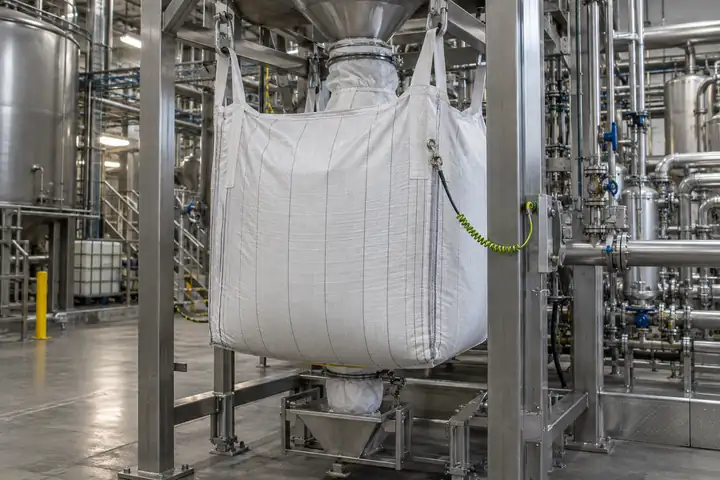
Type C bulk bags, often called conductive or groundable FIBCs, are woven with conductive threads in a grid or stripe pattern, all interconnected and brought to one or more grounding tabs. During filling and discharge, the tab is clipped to a verified ground point, and the charge drains away. The standard sets a maximum resistance between any part of the conductive network and the grounding point.
The weakness of Type C is human: an ungrounded Type C bag is more dangerous than a Type A bag, because the conductive network can store charge and discharge it as a single spark. Use them only where grounding is part of a written procedure and ideally verified by an interlocked grounding monitor on the filling or discharge station (see our filling and discharging equipment guide).
Type D FIBC
A Type D FIBC uses fabric with special static-dissipative threads that release charge into the air as low-energy corona discharge, so no grounding connection is needed. That removes the risk of an operator forgetting the clip. Type D bags are widely used in chemical and pharmaceutical plants. Their performance depends on the fabric surface staying effective, so heavy contamination with conductive liquids, grease or coatings should be avoided, and the supplier's handling instructions for that design should be followed.
What about anti-static bulk bags and liners?
"Anti static FIBC" and "anti static bulk bags" are marketing terms, not types. A supplier may use them for Type B, C or D, or simply for a bag with an anti-static additive. Always ask which IEC 61340-4-4 type the bag is, and for test evidence on that design.
Liners need the same attention. A standard polyethylene liner is an insulator and can defeat the protection of a Type C or D bag. IEC 61340-4-4 also classifies liners, and the liner and bag must be tested or specified as a compatible combination. Our bulk bag liners guide explains liner types in more detail.
What are UN certified bulk bags?
UN certified (or UN approved) bulk bags are FIBCs that have been design-type tested and approved for transporting dangerous goods under the UN Recommendations on the Transport of Dangerous Goods, as implemented in modal rules for road, rail, sea and air. They are needed for regulated substances such as many oxidizers, corrosive solids, toxic powders and certain fertilizers.
UN 13H codes
The UN code tells you the construction:
| Code | Construction |
|---|---|
| 13H1 | Woven plastic, without coating or liner |
| 13H2 | Woven plastic, coated |
| 13H3 | Woven plastic, with liner |
| 13H4 | Woven plastic, coated and with liner |
| 13H5 | Plastic film |
"13" means a flexible IBC and "H" means plastic material. After the code comes a letter for the packing groups the design is approved for: Y for packing groups II and III, or Z for packing group III only. FIBCs are not permitted for packing group I.
A UN mark also shows the month and year of manufacture, the country of the approving authority, the manufacturer's code, the stacking test load and the maximum permissible gross mass, for example: UN 13H3/Y/09 26/[country]/[maker code]/[stacking load] kg/[gross mass] kg.
How UN bags are tested
UN design-type testing goes beyond the ISO 21898 tests for non-dangerous goods. It includes a top-lift test to six times the maximum permissible gross mass, plus drop, topple, righting, tear and stacking tests, and the manufacturer must run an approved quality program. A UN bag must only be used for products and packing groups within its approval, filled to no more than its marked gross mass, and closed as specified. Check the safety data sheet of the substance for its UN number and packing group, and confirm the requirements with your dangerous-goods adviser.
Other ways FIBC types are classified
Electrostatic type is only one axis. Bulk bags are also classified by:
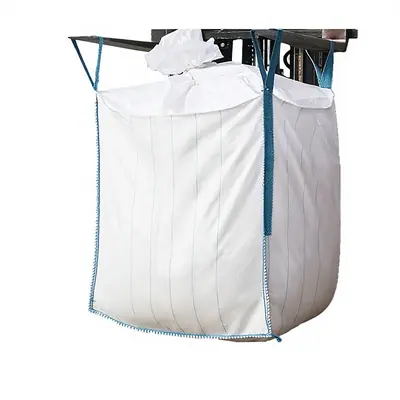
- Construction: U-panel, four-panel, circular (tubular) and baffle bags. See baffle bulk bags and Q-bags.
- Use: single-trip (5:1) or multi-trip (6:1).
- Hygiene: standard industrial or food grade bulk bags made in controlled production.
- Ventilation: breathable or vented bags for firewood, potatoes and onions, such as our 1000kg PP Tubular Jumbo Ton Bag Breathable Load-Bearing.
Which FIBC type for the chemical industry?
Bulk bags for the chemical industry usually need the most careful specification, because many chemical powders are combustible and solvents are often present in the same building. A practical approach:
- Check the product's MIE and whether flammable vapors or gases may be present in the filling or discharge zone.
- No combustible dust and no flammable atmosphere: Type A is acceptable.
- Combustible dust (MIE above 3 mJ), no flammable gas or vapor: Type B, C or D.
- Flammable gas or vapor present, or very sensitive dust: Type C with verified grounding, or Type D.
- Regulated dangerous good: a UN certified bag of the right 13H code and packing group, in addition to the correct electrostatic type.
- Fine or hygroscopic powder: coated fabric or a compatible liner, and a discharge spout such as on our Large Capacity Jumbo Bag Integrated Discharge Outlet.
For fine chemical powders that also need clean handling, a tubular body reduces sifting through seams; see our PP Food Grade Tubular Woven Bulk Bag 1 Ton Antistatic.
Which FIBC bags for minerals and mining?
Most FIBC bags for minerals and mining — sand, silica, bentonite, barite, ores, concentrates, cement and lime — are Type A, because the products are not combustible and are handled outdoors or in open sheds. The demands are mechanical instead:
- High SWL, often 1,500–2,000 kg, with heavier fabric and reinforced loops; see our Industrial Grade PP FIBC Jumbo Bags 500-2000kg Durable.
- Abrasion resistance for sharp or angular particles.
- UV stabilization for stockpiles at mine sites and ports.
- Coating or liners for fine dusts such as silica flour to stop sifting and protect workers.
- One or two lifting loops on mineral bags that are lifted by crane hook in large numbers.
Exceptions exist: some sulfide ore concentrates, coal dust and metal powders are combustible or reactive, and some mineral products are classified as dangerous goods. When in doubt, follow the chemical-industry steps above. Our guide to bulk bags for sand, gravel and aggregates covers the construction side.
Specifying the right type from EGP
EGP (Yantai Evergreen Packaging) manufactures woven PP bulk bags in Yantai, China, for importers, distributors and industrial users. When you request a quote, tell us the product, its MIE or safety data sheet, whether flammable atmospheres are present and whether the product is a regulated dangerous good. We will confirm which constructions we can supply for your case and send a drawing for approval. Browse our FIBC Bulk Bags or contact us.
Frequently asked questions
What is the difference between Type C and Type D bulk bags?
Both are suitable for combustible dusts and, under the right conditions, flammable atmospheres. Type C uses conductive threads that must be connected to ground every time the bag is filled or emptied. Type D uses static-dissipative fabric that needs no ground connection, which removes the risk of a forgotten clip.
Can I use a Type A bag for flour or sugar?
Not where dust explosion risk exists. Flour, sugar and starch are combustible dusts, so a Type B, C or D bag is normally specified depending on whether flammable vapors are present. Your site's explosion risk assessment should decide the type.
What does 13H3 mean on a bulk bag?
13H3 is a UN code for a flexible IBC made of woven plastic with a liner. It appears only on UN certified bulk bags approved for dangerous goods, followed by Y (packing groups II and III) or Z (packing group III only).
Are anti static FIBC bags the same as Type C?
Not necessarily. "Anti-static" is a general term that suppliers use for Type B, C or D bags, or for fabric with an additive. Always ask for the IEC 61340-4-4 type and the supporting test data.
Do I need UN approved bulk bags for fertilizer?
It depends on the product. Many fertilizers are not dangerous goods and can ship in standard bulk bags, but some ammonium nitrate based products are regulated. Check the safety data sheet for a UN number and packing group before choosing the bag.